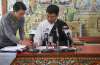



Dharamshala — Seven Tibetan activists, including an 82-year-old elder, successfully concluded their peace march in Salugara, on Thursday. The march was held to honor the memory of Tibetan martyr Lobga Rangzen and demand justice for his ultimate sacrifice. Additionally, the marchers sought to voice their strong protest against China's controversial "Ethnic Unity and Progress Law" and condemn President Xi Jinping’s oppressive policies in Tibet ahead of his anticipated visit to India.
As they journeyed along the streets, the activists distributed more than 300 pamphlets outlining their three core demands. To ensure their message reached everyone, they also took the time to verbally explain the aims of the peace march to those who could not read, successfully raising vital awareness about the critical situation inside Tibet and the broader Tibetan cause.
The 68-kilometer peace march undertaken by seven Tibetan activists successfully concluded at the Kalchakra Monastery in Salugara, on September 3, 2026. The march commenced in Kalimpong on September 2 to mark the exact two-month anniversary of the passing of Tibetan martyr Lobga Rangzen. The participants included 82-year-old Pema Dhundup, 48-year-old Thinley Choden, 31-year-old Nawang Tsundu, alongside Tashi Dhondup, Lhundup Chonden, Leksang Phengay, and Tenzin Jamphel.
The Tibetan martyr Lobga Rangzen—who died on July 2, 2026, after self-immolating in front of the United Nations headquarters in New York to denounce the China's repressive laws and assimilation policies in Tibet (notably the "Law on Promoting Ethnic Unity and Progress") and demanded freedom in Tibet and the restoration of Tibet's independence—it is fitting to recall that he became the 171st known Tibetan to self-immolate in a call for freedom for Tibet and the return of His Holiness the Dalai Lama to Tibet.
The executive members of RTYC demanded justice for Pawo Lobga Rangzen, who died outside the UN Headquarters during a protest calling on the UN to bring freedom and justice to the Tibetan people. His sacrifice highlighted the severe human rights violations in Tibet and the denial of basic freedom of expression. Activists also urged the international community to honor the justice sought by the 157 known self-immolators inside Tibet, who gave their lives demanding Tibetan freedom and the return of His Holiness the Dalai Lama.
They said,"we condemn China’s newly implemented so-called "Ethnic Unity and Progress Law", the aimed at suppressing Tibetan identity, culture, language and freedom."
The National People's Congress (NPC) passed a law titled “Promotion of Ethnic Unity and Progress”, on March 12, 2026. This law reinforces policies of “Sinicization” and “assimilation,” particularly with regard to Tibetans and other oppressed peoples of Mongolia and East Turkestan. It mandates the Sinicization and assimilation of the Tibetan people, using parents, monasteries, various social organizations, and state institutions as instruments of implementation; the law officially took effect on July 1, 2026.
The new law aims to codify Xi Jinping’s policy on ethnic affairs, which promotes greater integration and cultural assimilation under the Chinese Communist Party (CCP) regime. It prioritizes the use of Mandarin in education, public services, and public life, thereby replacing previous policies that allowed instruction in minority languages such as Tibetan, Uyghur, and Mongolian. It also requires religious practices to align with Han-centered Chinese cultural norms and socialist values through the “Sinicization” of religion.
U.S Senator Jacky Rosen,Jeff Merkley, John Curtis, and Jim Banks, introduced a Bipartisan Resolution on the China's “Ethnic Unity and Progress Law” in US Senate on June 24, 2026. The resolution condemns China’s "Ethnic Unity and Progress Law," which entered into force on 1 July 2026, and calls on Beijing to end abuses against ethnic and religious minorities, as well as campaigns of transnational repression affecting people in the United States.
UN human rights bodies have expressed serious concerns regarding the “Law on Promoting Ethnic Unity and Progress" of PRC. They said, “we observe that the newly adopted Law risks restricting the freedom of expression, the right to take part in cultural life, freedom of religion and belief, the rights of persons belonging to various communities, particularly children, to use their own language and conduct their own cultural practices, the right of all persons to quality education and training that fully respect their cultural identity, academic and artistic freedoms, and the right to freedom of assembly and association, as protected under international human rights treaties.”
The Tibetan Parliament-in-Exile condemned China’s so-called “Law on Ethnic Unity and Progress” and stated: “Lasting peace cannot be achieved through forced assimilation. Lasting unity cannot be built by erasing identity. ” It further urged the international community to closely monitor this law, express concerns about it, and pressure China to engage in peaceful dialogue to resolve the Sino-Tibetan issue, adding: “Tibet’s future must be built through dialogue, not assimilation; through justice, not coercion.”
Sikyong Penpa Tsering said, "The Chinese Communist government’s so-called “Law on Promoting Ethnic Unity and Progress,” which took effect on July 1, demands a firm and appropriate response. The legislation includes severe restrictions on the Tibetan language; the falsification of history and identity; forced cultural assimilation at the grassroots level; the Sinicisation of Tibetan Buddhism; enforced ethnic integration; pervasive technological surveillance; political and social coercion; the political vetting of Tibetan cadres; the violation of regional autonomy rights; and the assertion of extraterritorial jurisdiction targeting organisations and individuals worldwide."
Chinese President Xi Jinping is expected to visit New Delhi, India, to attend the 18th BRICS Summit scheduled for September 12–13, 2026. The Tibetan activists said," Xi Jinping, you are not welcome to India," directly to protest the Chinese government's forced cultural assimilation, intensive surveillance, and severe restrictions on the religious and basic freedom of expression of the Tibetan people inside Tibet and to protest against the law recently implemented by China—known as the "Ethnic Unity and Progress law"—which aims to eradicate Tibetan language, culture, religion, and identity, and which also targets those fighting for their people's freedom and human rights under Chinese occupation.